Frost inside a freezer that is supposed to defrost itself narrows down quickly, because where the ice sits says which system stopped. A sheet across the rear panel, a slab under the drawer, a rim on the door gasket and a dusting on food packages point in four different directions. The first two are a paid repair, the third is either a setting or a worn gasket, and the fourth is often normal in a room that is not air conditioned.
What is a no-frost freezer actually doing?
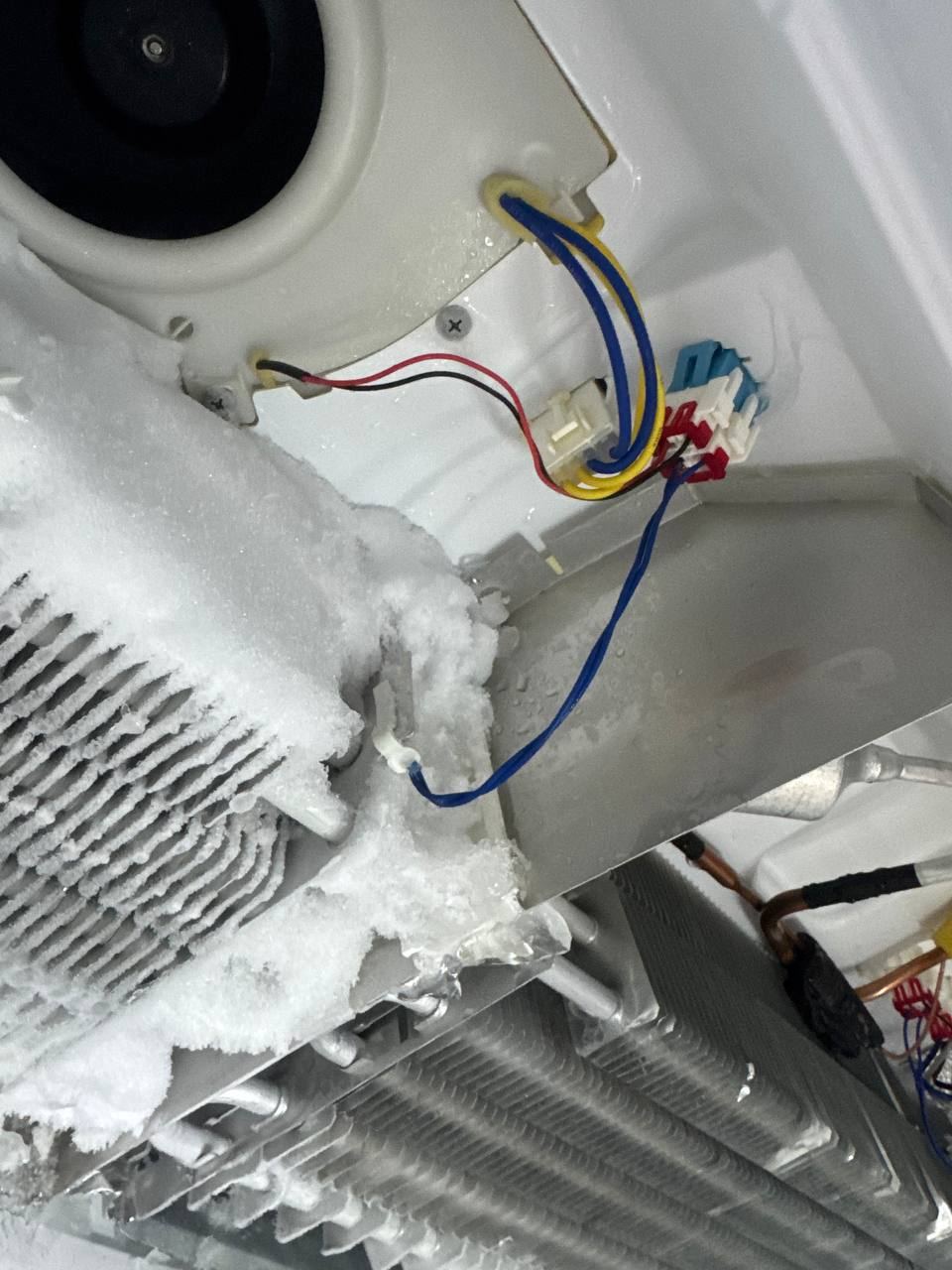
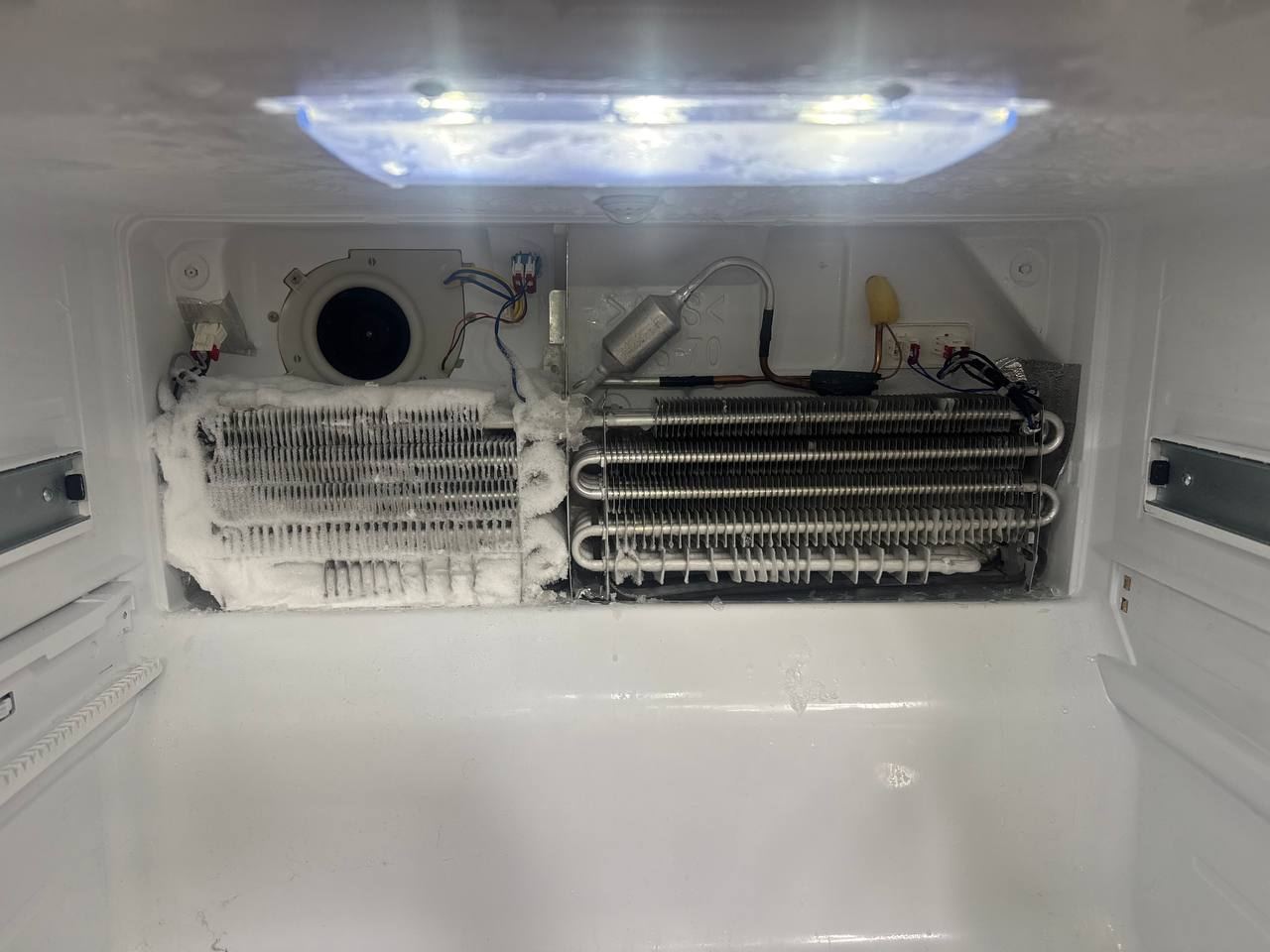
The cold is made at an evaporator coil hidden behind the rear panel, not in the compartment you load. A fan pulls freezer air across that coil and pushes part of it through vents into the fresh food compartment. Moisture riding in that air freezes onto the coil by design, every day the machine runs. The part nobody sees is the removal: a heater against the coil runs periodically to melt the frost off, and the melt water drains down a tube into a pan under the machine, where it evaporates.
When the melting step stops, the frost that arrives every day stops leaving. Over several weeks it fills the space between the fins and becomes a solid block. The coil is still cold, so the freezer still freezes. What the machine loses is airflow.
Why does the fridge get warm while the freezer stays cold?
Because on most designs the fresh food compartment has no cooling of its own. Whirlpool's guidance for side-by-side models states, and the same airflow applies to any single-evaporator machine, that cool air enters and exits the refrigerator compartment through vents from the freezer compartment. Ice between the fins blocks that path. The freezer sits against the coil and keeps working. The fresh food side is at the far end of the run and gives up first.
One thing you can hear. A rhythmic ticking or chirping that starts once the door closes is worth noting, because the door switch stops the evaporator fan while the door is open. A blade striking ice is one cause. A worn fan motor bearing makes a similar chirp with no ice at all, so the sound narrows the problem without settling it.
If the fridge is warm and the freezer is fine but there is no frost visible anywhere, that is a different path, and the guide on a refrigerator that will not cool while the freezer works covers it.
Which checks are free?
Five, and none of them need a tool you do not already own.
Close the freezer door on a dollar bill and pull. Do it at eight or ten points around the gasket, including the bottom corners, where seals go first. A bill that slides out with no resistance marks a section that is not sealing, and one failed corner lets a steady trickle of room air onto the coil all day.
Check that nothing is holding the door open a fraction of an inch. An over-filled drawer, a box behind the ice bin, or an ice bin sitting proud of its rails will do it. Whirlpool's instruction is to make sure the door closes completely and that nothing is obstructing the gasket.
Press the freezer door switch in with a finger while the door is open. The light should go out. On most machines that same switch stops the evaporator fan, so a switch stuck closed leaves the fan pulling room air in every time the door opens. That is the fastest way there is to build frost.
Check the vents between the two compartments. Whirlpool states that blocked vents cause moisture build-up or excessive frost, and a stack of containers pressed against a vent is a common way to get there.
Find the Energy Saver or Humidity control if the model has one. Whirlpool states that this feature controls a heater that helps reduce moisture on the vertical hinged seal, and the two labels run in opposite directions. On a Humidity or Moisture Control the heater runs when the feature is on. On an Energy Saver the heater runs when that switch is off. Whirlpool's guidance is to turn Energy Saver off if you see moisture on the gaskets, the center mullion or the cabinet seams. It is a setting rather than a repair.
One result worth accepting: Whirlpool states that some frost and sweating on interior walls or food packages is normal in humid months, especially in a home that is not air conditioned. A garage refrigerator in the West Valley spends its summer in that situation, and light frost on packages in August is not the same fault as a solid sheet on the rear panel.
Ice on the freezer floor is a different fault
Water that pools and freezes on the floor of the freezer, or on a top-freezer model drips into the fresh food compartment underneath, usually means the defrost drain is blocked. Here the defrost cycle is normally still running. The melt water cannot leave, so it backs up under the coil, refreezes, and every cycle adds to it. On a bottom-freezer model it shows as a slab under the drawer and a puddle on the floor. That is a drain clearing job, and it is worth knowing which of the two you have before anyone quotes a heater.
Should you melt it out with a hair dryer?
The argument against it is practical before it is about safety. Clearing the ice gives the fan its airflow back for a while, then the frost returns, because nothing in the defrost circuit changed.
The safety side is real too, though not in the way most warnings put it. A heat gun or hair dryer held against the liner melts the plastic, and water driven into the insulation stays there. Many refrigerators built in recent years are charged with isobutane, listed as R-600a, and it is flammable. Heat alone will not release it, because the refrigerant is sealed inside the tubing. The risk is mechanical: that tubing runs through the ice, it is soft aluminum, and an ice pick goes straight through it. Never chip and never pry.
The version that does no damage: move the food to a cooler, unplug the machine, and leave both doors open for twenty-four to forty-eight hours until the rear panel is dry. Plug it back in and write the date down. Frost back inside a month is the defrost circuit. Frost that takes many months is the door.
What happens to the food meanwhile?
A freezer losing airflow to a block of ice is not a power outage, and the two compartments are not at equal risk. The coil is still cold, so the frozen food is usually the last thing to suffer. The compartment to watch is the fresh food side, the one no longer receiving air.
FoodSafety.gov gives a refrigerator up to 4 hours once it stops being cooled, with an item by item chart for what to keep and what to throw. Its freezer figures, roughly 48 hours full and 24 hours half full with the door closed, only apply if the freezer compartment itself climbs. Food that still contains ice crystals or is at 40°F or below may be safely refrozen, though the quality suffers. Ice cream and frozen yogurt are discarded whether or not ice crystals remain, and the standing instruction is not to taste anything to decide.
Where does the self-help stop?
At the rear panel. Behind it sit the evaporator, the defrost heater and the bimetal thermostat that allows that heater to run. The panel comes off only with the appliance unplugged, the heater is a live circuit while it operates, and the coil is soft aluminum.
The diagnosis behind that panel is also not a matter of looking. A defrost heater that has gone open circuit sometimes shows a cracked sheath or a burned section, but often it looks untouched, and a bimetal thermostat that has stopped closing to feed it never looks different from a working one. Neither makes a noise. Nothing happens, and the frost accumulates. Separating those from an adaptive defrost control that is not calling for a defrost at all needs a meter and the service mode for that model. A seized fan motor is a separate matter, and on an iced coil it is usually the consequence rather than the cause.
When the free checks run out, we do refrigerator repair and freezer repair across the West Valley same day, out of the shop at 6950 Remmet Ave in Canoga Park. Hours are Monday to Thursday 7:00 am to 7:00 pm, Friday 7:00 am to 5:00 pm, closed Saturday, and open Sunday 7:00 am to 7:00 pm. We service Sub-Zero, Wolf, Viking, Thermador, Miele, Bosch, KitchenAid, Whirlpool, Maytag, GE, Frigidaire, LG, Samsung, Kenmore and Haier. Licensed and insured, BHGS #49468, verifiable through the Bureau of Household Goods and Services. Call (818) 325-5525, price is agreed before we start. We are ASL proficient, and deaf and hard-of-hearing customers can book here.
Questions we get
Why is my fridge warm when the freezer is still freezing?
On most designs the fresh food compartment has no coil of its own. It is cooled by air blown across the freezer evaporator and pushed through vents. Whirlpool describes this airflow directly, stating that cool air enters and exits the refrigerator compartment through vents from the freezer compartment. When ice fills the space between the coil fins, that air stops moving. The freezer sits next to the coil and stays cold. The fresh food side is at the far end of the airflow path and warms up first.
Will melting the ice out fix it?
It restores airflow for a while, then the frost returns, because nothing in the defrost circuit changed. The useful part is the timing. Clear it properly by unplugging the machine and leaving both doors open until the rear panel is dry, then write the date down. Frost back within a month points at the defrost system. Frost that takes many months to come back, on a garage machine opened constantly through summer, points at air getting in instead.
How long is the food safe while this is going on?
On an iced-up machine the frozen food is usually the last thing at risk, because the coil is still cold. The compartment to watch is the fresh food side, and FoodSafety.gov gives it up to 4 hours once it is no longer being cooled. The freezer figures, approximately 48 hours full and 24 hours half full with the door closed, only start to matter if the freezer compartment itself climbs. Food that still contains ice crystals or is at 40°F or below may be refrozen with some loss of quality, and ice cream and frozen yogurt are discarded either way.