A refrigerator that seems never to shut off sounds like a machine in trouble, and most of the time it is not. Long run time became normal when compressors became efficient. What still tells you something is wrong is the temperature the box holds while all that running is going on.
The manufacturer puts a number on it
Whirlpool's own guidance on new refrigerators says the motor will run about 40% to 80% of the time at normal room temperatures, and that under warmer conditions it could run even more. Eight hours in every ten is already indistinguishable from constant if you are standing in the kitchen listening for it.
The reason is in the compressor. Whirlpool describes a high-efficiency compressor as designed to optimize energy and better regulate temperatures to match cooling demand, and says it is normal for that compressor to run for extended periods at varying speeds to consume only the energy necessary for optimal efficiency. A motor that varies its speed does not need to stop. It throttles down instead, which removes the on and off rhythm people used as a health check on an older machine. That habit needs replacing with something measurable.
Measure the box, not the motor
The FDA's instruction is to keep a refrigerator at 40 degrees F or below and the freezer at 0 degrees F, and it points out that few refrigerator controls show actual temperatures, so an inexpensive freestanding appliance thermometer is what lets you monitor the real number and adjust the setting.
Put that thermometer in a glass of water on a middle shelf rather than clipped to a shelf in open air. Air temperature swings every time the door opens and settles again within minutes, which is why two people can take readings an hour apart and disagree. Water holds its temperature the way food does. Leave it overnight and read it in the morning before anyone opens the door for long. The FDA's advice is one thermometer for the fridge and one for the freezer, so put a second one on a freezer shelf, sitting dry rather than in water, and read it the same way.
That reading splits the problem in two.
- Box at temperature, motor running most of the time. The machine is keeping up. Something is adding heat or slowing heat from leaving, and the checks below are the cheap ones. This narrows the list rather than closing it, because a door seal, a stopped condenser fan and an early evaporator airflow problem all start here.
- Box warm, motor running most of the time. The machine is not keeping up, and that is the list further down.
What September adds in the Valley
Whirlpool states that its refrigerators are designed for indoor, household use only, intended for use in a location where the temperature ranges from a minimum of 55 degrees F to a maximum of 110 degrees F, and that operating outside the recommended range may result in improper temperatures, temperature fluctuation, or the refrigerator not operating at peak performance.
A closed garage with the door facing afternoon sun holds its heat well after sunset, which is the part people miss. The second refrigerator out there is rejecting heat into air warmer than the kitchen all evening, so it runs longer for the same result. That is the room talking rather than the machine.
The same guidance says to avoid installing a refrigerator near an oven, radiator, or other heat source, and, for best performance, not to install it behind a cabinet door or block the base grille. A panel that makes the refrigerator disappear into the cabinetry can also stop it breathing.
Where the heat actually leaves
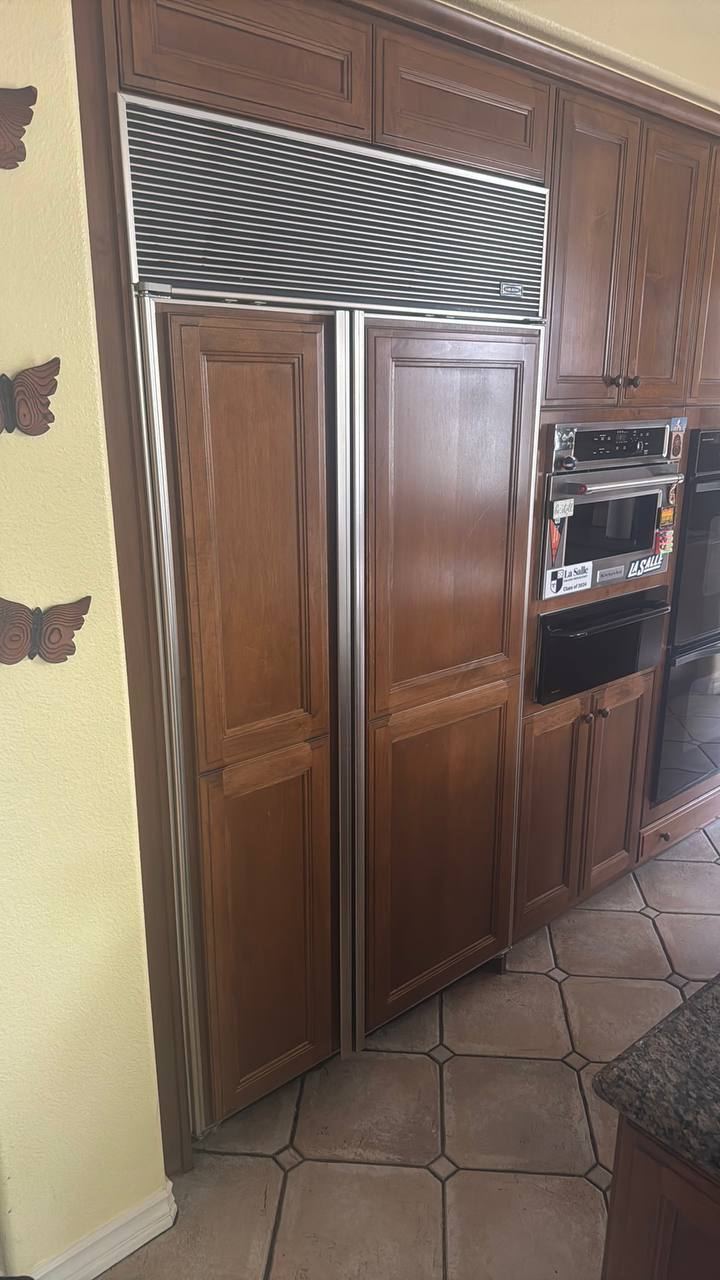
Every refrigerator dumps the heat it takes out of the food into the room, and it does that through a condenser. On a freestanding machine that condenser usually sits behind the base grille at floor level. On the built in above it is behind the louvered grille at the top, which is worth knowing before anyone goes looking along the floor for a panel that is not there. Either way that opening is the machine's airway, and a grille packed with dust, a box pushed against the back or a cabinet door closed across the front all do the same thing to run time.
Coils matter less often than the internet says
This is where most advice overstates the case. Whirlpool's cleaning page says that in a normal home operating environment, routine condenser cleaning is not typically needed, and that households with pets, heavy kitchen traffic, or dust from construction should inspect and clean every 3 to 6 months. It also says some models do not require the coils to be cleaned, and that on others, in Whirlpool's words, they "can only be cleaned by a certified technician."
So the honest version is that coils are worth checking in a house with a shedding dog or after a remodel, and mostly not the answer in a quiet household. If yours is in that group, Whirlpool's procedure is to unplug the refrigerator or switch off the breaker first, remove the base grille by opening both doors and pushing in on its top while pulling up on the bottom, then vacuum the grille and the open area behind it with a soft brush attachment, leaving the ice and water lines alone and avoiding the condenser fins and tubing.
The load you put in yesterday
Whirlpool's list of ordinary reasons starts with the one nobody connects to the noise. Adding a large amount of food or beverages raises the temperature inside, the motor runs longer to bring it back down, and the guidance is to wait 24 to 48 hours for normal temperatures to return. A recently installed refrigerator may also take 24 to 48 hours to reach the correct temperature.
Frequent door openings do it too. So does the control setting: Whirlpool notes the controls are preset at the factory to the mid setting, which should be correct for normal household use, and that setting them too low can cause the refrigerator to run longer than it needs to. Turning the dial colder because the machine seemed to be struggling is a common way to make the running worse.
When the door is the reason
A door that is not sealing may lead to frost build up, temperature fluctuation, and the door switch being unable to make contact correctly, which is Whirlpool's own list. The gasket is the usual suspect and rarely for the reason people assume. Its page says the gaskets need cleaning regularly so the doors open and close properly, because dirt and other particles can accumulate on the gasket surface and cause resistance. Sticky rubber does not pull the door the last fraction of an inch closed.
Close the door on a strip of paper and pull it out. Do that at several points around all four sides, because a gasket usually fails in one place rather than everywhere. Paper that slides out with no grip marks the spot.
Level matters more than it sounds. Whirlpool's guidance is to make sure the refrigerator is level side to side and front to back before adjusting the doors, and to check the floor under it as well, since shims may be needed.
When constant running is a fault
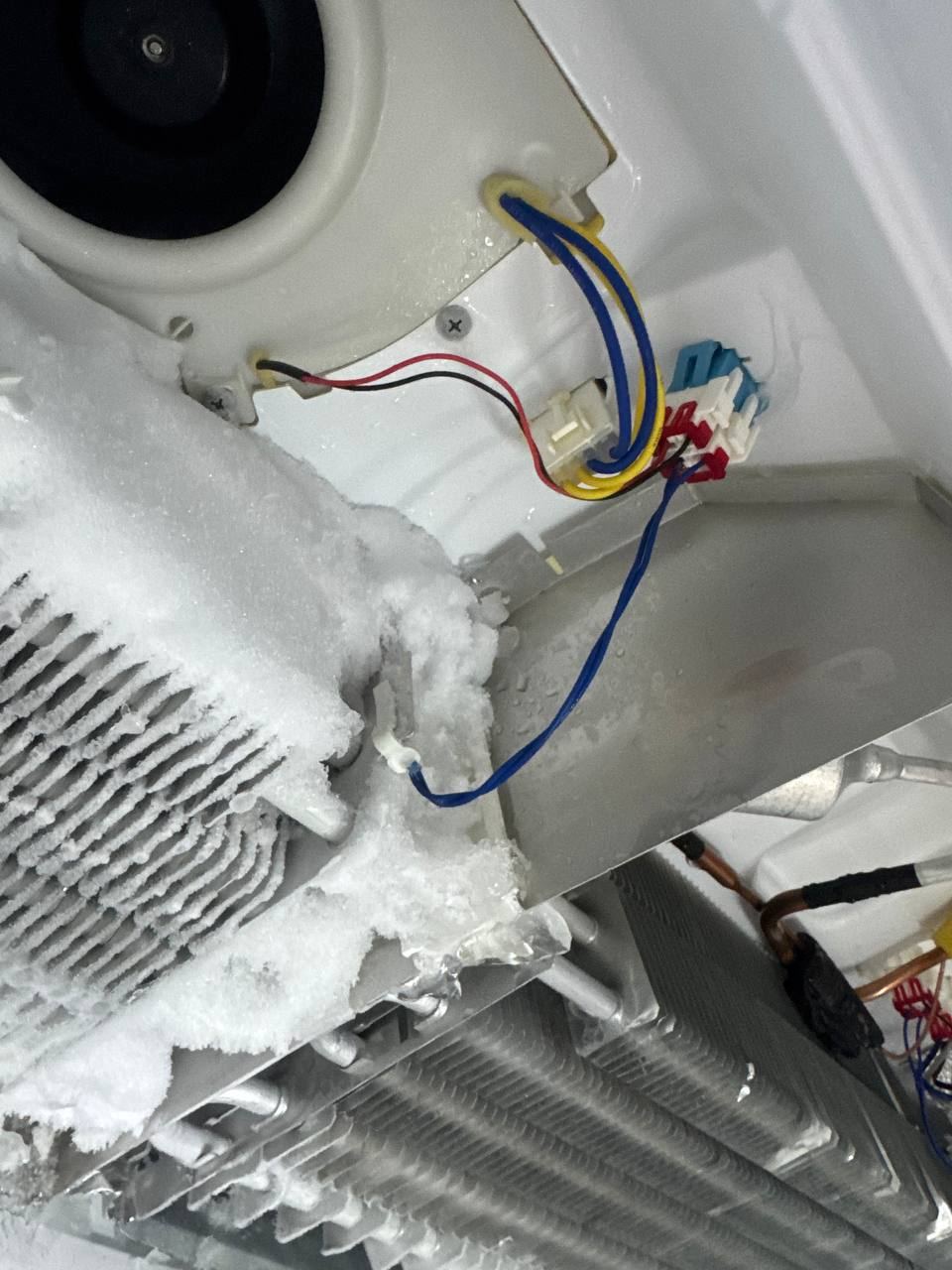
Go back to the reading. A warm box with the motor running most of the time means the machine is losing, and the usual reason is air rather than cold. Cold is made at the evaporator, and a fan pushes air through its fins out into the compartments. Frost filling that fin pack, as in the photo above, leaves the fan pushing against a block of ice. The compressor keeps running because the box never reaches its setting, and the box never reaches its setting because almost no air is arriving.
That pattern usually arrives gradually rather than overnight, and the freezer often still feels cold while the refrigerator section goes warm first. Two related symptoms are worth reading alongside this one: frost on the freezer back wall, which is the same fault caught earlier, and a refrigerator that is warm while the freezer works, which is where the airflow split shows up most clearly.
The other check that needs no tools is the condenser fan. On most freestanding machines it sits in the machine compartment at the bottom, reached from the base grille at the front or an access panel at the back, and it normally turns while the compressor runs. Do this one with the grille still in place. With the compressor running, hold a hand near the louvers and feel for warm air coming out. If the compressor is running and no warm air is moving at all, heat is not being carried away into the room. Do not take the grille off to look, because that fan restarts on its own.
Where to stop
Unplug the refrigerator before pulling any grille or panel. The condenser fan starts by itself when the compressor calls, and a rear panel in a freezer has a defrost heater behind it.
Do not try to thaw a frosted evaporator with anything hot or sharp. The evaporator fins are thin aluminum and the tubing running through them carries refrigerant. Whatever made the frost build up is still there after the ice is gone, so melting it is a test rather than a repair.
The sealed side is the hard boundary. Refrigerant, the compressor and the tubing between them are a closed system, and intentionally venting refrigerant while servicing or disposing of refrigeration equipment is prohibited under EPA Section 608. Nothing you can buy in a can belongs in a household refrigerator.
We handle refrigerator repair across Canoga Park, Woodland Hills and the rest of the West Valley. Manufacturer guidance above comes from Whirlpool's pages on how a new refrigerator differs from an old one, a motor or compressor that runs too much, cleaning condenser coils and doors not sealing. Storage temperatures come from the FDA's page on refrigerator thermometers.
Questions we get
My refrigerator runs almost all day. How much running is too much?
Whirlpool puts a number on its own new refrigerators: at normal room temperatures the motor will run about 40% to 80% of the time, and under warmer conditions it could run even more. Eighty percent already sounds constant to anyone listening for it, and a Valley kitchen in September is not a normal room temperature. Run time on its own does not tell you there is a fault. The temperature inside the box does.
Does a refrigerator that runs constantly mean the coils need cleaning?
Not usually, and Whirlpool's own cleaning page is more careful about this than most advice online. Its wording is that in a normal home operating environment, routine condenser cleaning is not typically needed, and that households with pets, heavy kitchen traffic, or dust from construction should inspect and clean every 3 to 6 months. It also notes that some models do not require the coils to be cleaned at all, and that on others, in Whirlpool's wording, they can only be cleaned by a certified technician. Check the manual for yours before pulling a grille off.
Is it bad to keep a second refrigerator in the garage?
It depends on how hot the garage gets. Whirlpool states that its refrigerators are designed for indoor, household use only, intended for a location where the temperature ranges from a minimum of 55 degrees F to a maximum of 110 degrees F, and that operating outside that range may result in improper temperatures, temperature fluctuation, or the refrigerator not operating at peak performance. A closed Valley garage in late summer spends part of the day near the top of that range, so a garage unit running far more than the one in the kitchen is usually responding to the room rather than breaking.