A washer that fills, washes and then hands you a drum of soaking clothes has stopped somewhere in a chain of permissions. It will not spin until it believes the tub is empty, the machine is standing square on all four feet, the load is balanced enough to be safe, and the lid or door is locked. Any one of those can fail without a part being broken, which is why the simplest checks come first.
Did the water actually leave the tub?
Start here, because a drain fault and a spin fault produce the same complaint. Most electronically controlled washers read the water level with a pressure switch or sensor and will not take the basket to high speed while that sensor still reports water. That is the control refusing on purpose rather than a broken part. Older timer-driven top loaders behave differently and spin while the pump is still clearing the tub.
Open the lid or look through the glass at the end of the cycle. Standing water in the drum, or clothes sitting in a puddle rather than just wet, usually means the drain path is the problem rather than the drive. That is a different set of parts, and it has its own article: why a washer will not drain. If the tub is empty and the clothes are simply saturated, the drain did its job and the basket never turned.
Is it the load rather than the machine?
This is the most common reason a healthy washer ends a cycle with wet clothes.
Modern washers measure how much the basket wobbles before committing to high speed. If the load is lumped on one side, the control slows, tries to redistribute by tumbling, measures again, and repeats. After a set number of attempts most machines finish at low speed or skip the spin rather than beat the suspension apart. The cycle runs long and the clothes come out far wetter than normal: dripping if the spin was skipped, heavy but not dripping if it finished at reduced speed.
One bath mat on its own, a single comforter, or a bedsheet wrapped into a rope does it reliably, because water hides in the folds and the mass never spreads out. Overloading works from the opposite direction, since a front-load drum packed to the door cannot tumble at all.
Pull everything apart by hand, spread it evenly around the drum, and run a spin-only or drain and spin cycle. That cycle takes ten to twenty minutes depending on the model. Stay near it and listen. If the basket ramps up to a hard spin and the clothes come out normally damp, the load was the fault. If it hums, rocks, slows and quits again, keep reading.
Is the machine sitting level, and does that matter in a garage?
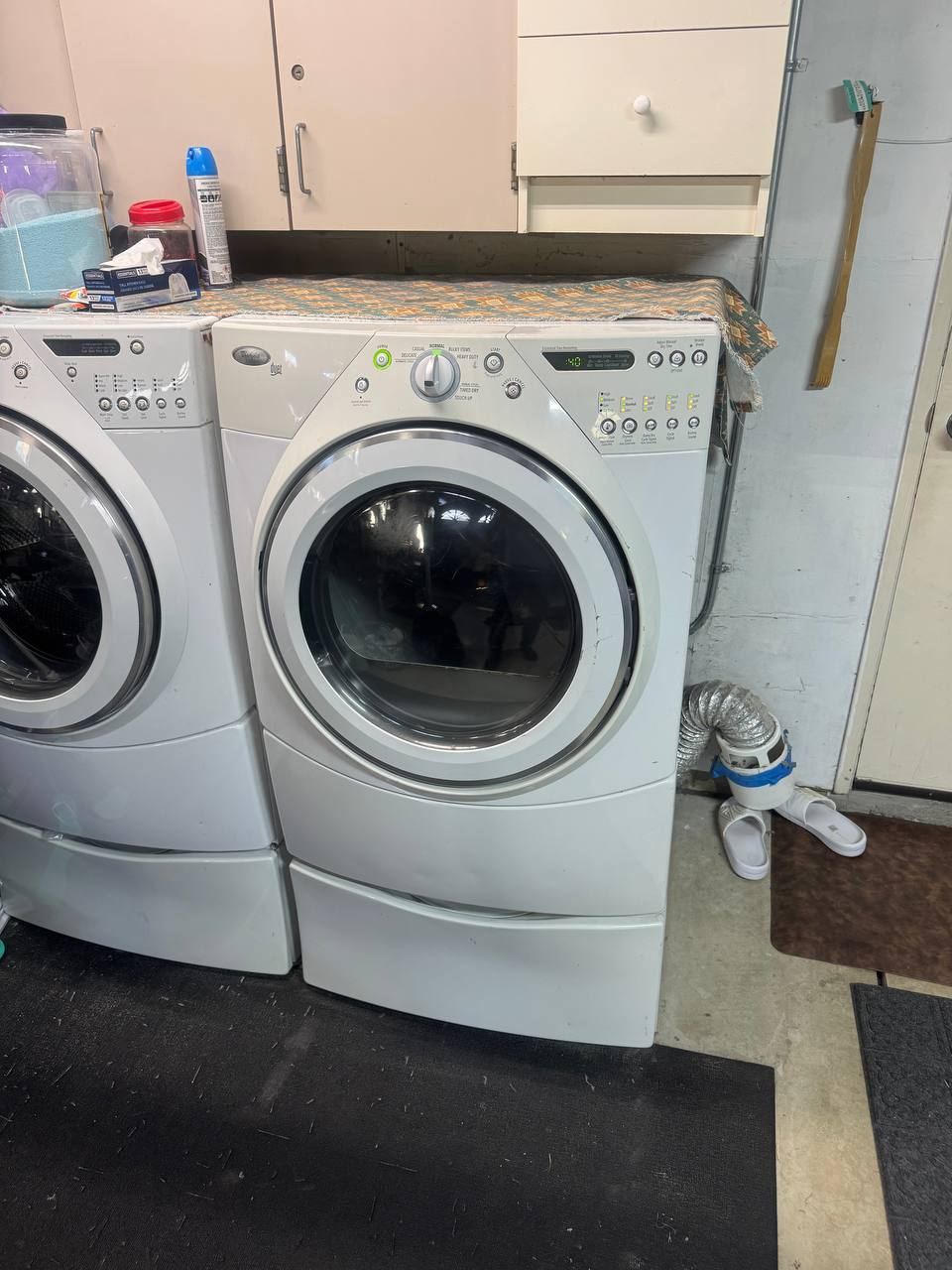
It matters more here than average, because so much Valley laundry lives in the garage, and a garage slab is not flat by accident. The residential code requires the area of a garage floor used for parking vehicles to be sloped so liquids move toward a drain or toward the main vehicle entry door, and no gradient is specified. A washer inside that area sits on concrete poured out of level on purpose, and a slab outside it is rarely much flatter. Storage pedestals do not change that angle, but they raise the center of gravity, so the same tilt puts more of the machine's weight out over the edge of its footprint, and rubber mats compress unevenly under the heavy corners.
Put a bubble level on the top panel, front to back and side to side, then push down on one front corner and the diagonally opposite one. Any rock means a foot is not carrying weight, and a machine standing on three feet will usually walk during spin and trip the imbalance detection. Front-load washers are the least forgiving, because the drum hangs on springs and dampers.
Is the lid or door lock giving permission?
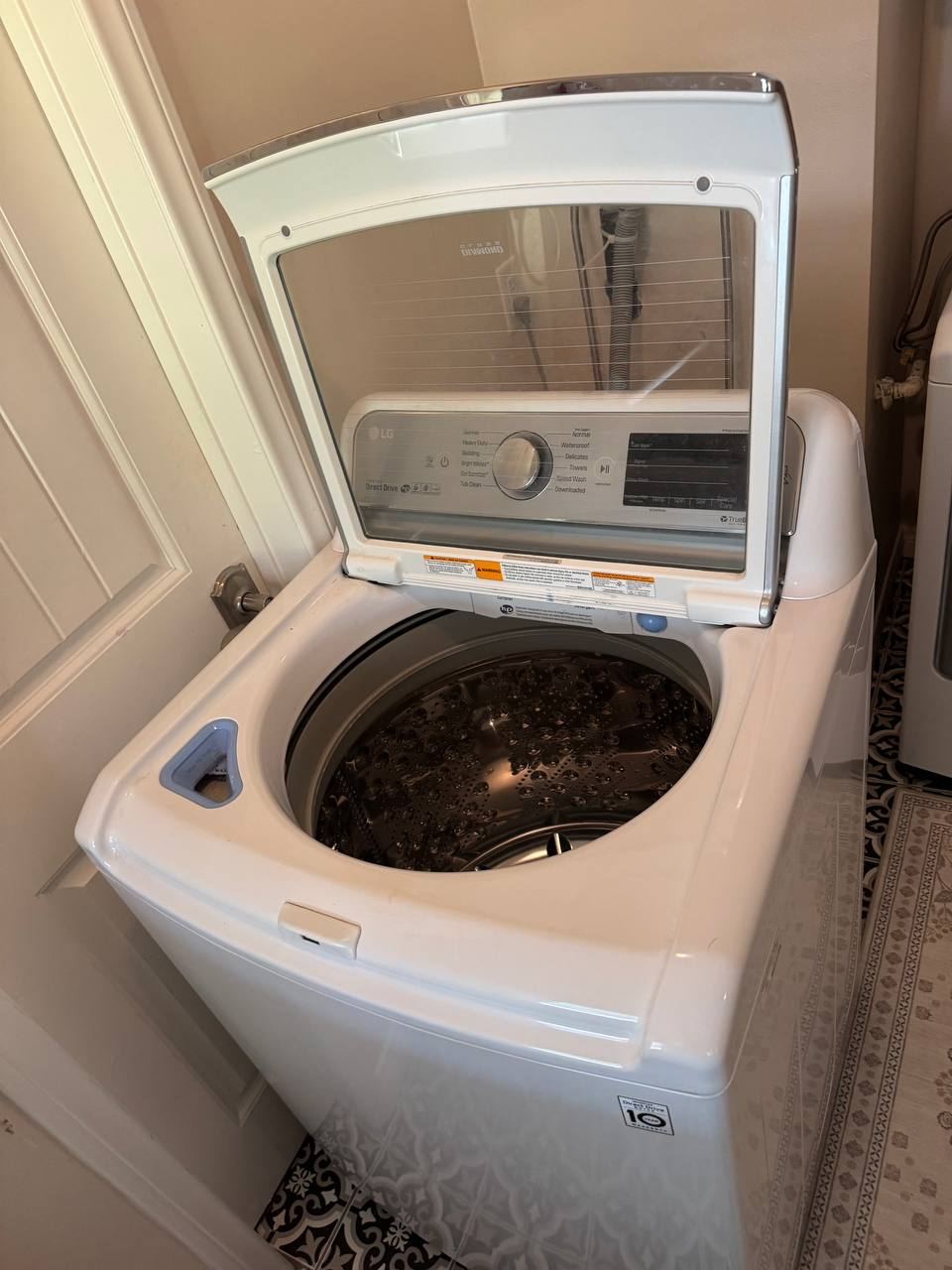
A washer treats the lock as a permission device. A front loader will not run at all with the door unlocked, because the door is the only opening into a drum that holds water and reaches high spin speed. Many modern top loaders fill and agitate with the lid closed but unlocked, then lock it before taking the basket to full speed, while others lock at the start of the cycle. Older top loaders use a plain switch that stops the spin when the lid rises.
The failure direction tells you which complaint you get. On a top loader that locks only before spin, a lock that never engages leaves a machine that washes and then stops with wet clothes, which is this symptom. A front loader with the same fault will not start at all. A lock that engages but never reports back looks identical to a lock that never engaged, on either type, since the board waits for a signal that never arrives. A lock that never releases is the opposite complaint, a finished cycle and a door you cannot open.
What you can see without tools is the strike or plunger and the slot it enters, which sits at the front edge on some machines and beside the hinge on others. A strike that is bent, cracked or missing its tip will not trip anything, and on a front loader a sagging hinge moves it out of line with the receptacle.
What actually turns the basket?
If all four conditions are met and it still will not spin, the fault is in the drive path or the control, and the sound narrows it down.
The motor runs and the basket does not move. On a belt-driven washer that is a stretched, glazed or thrown belt. On an older Whirlpool or Kenmore direct-drive top loader it is usually the plastic motor coupler between motor and transmission, which is designed to shear before the transmission does. That fault takes agitation with it, so the usual report is no wash and no spin. The clutch on that same platform fails differently: it slips, so the basket turns but never reaches speed. Either way you hear a motor working under no load.
The machine agitates or tumbles but never attempts a spin. On Whirlpool-family top loaders that use a shift mechanism to switch the drive between wash and spin, a shift actuator stuck in the wash position gives exactly this, and the wash half of the cycle looks completely normal. Stuck the other way it gives the opposite complaint, a basket that turns during the wash and never agitates. Either way the machine usually stores a shifter fault code.
Nothing happens where spin should start, and the motor is silent. That points back at the lock circuit, the speed feedback, or the control board. On washers driven by a brushless motor bolted straight to the basket shaft, which LG and Samsung also badge direct drive but which is a different design from the older Whirlpool direct-drive platform above, the control relies on rotor position and speed feedback to run the motor at all. Lose that feedback and the motor will not turn, and the machine normally stores a motor or rotor sensor fault.
What we check that you cannot from the outside
A meter on the lock circuit answers in a minute whether the lock is receiving voltage and whether it reports back, and the control's own record of water level and basket speed separates a sensor fault from a mechanical one. On front loaders we also push the empty drum down and let go. A healthy drum comes back to rest without repeated bouncing, and one that keeps bouncing has worn dampers that make the machine fail its own balance test with a load it used to handle. Bearing noise at spin is the other thing we listen for, and it is the finding that turns a repair into a conversation about whether the machine is worth keeping.
Where the do-it-yourself line sits
Worth doing yourself: redistribute the load, run a spin-only cycle, level the machine on all four feet, look at the strike and the door alignment, confirm the tub drained, and run the model number through the CPSC recall database.
Worth leaving alone: the outer cabinet, a front-load door lock during a cycle, and the lid switch circuit. Prying a front-load door open mid-cycle can empty a tub across the floor, and bypassing a lid switch removes the one thing between an open lid and a basket at full speed.
We repair washers across the West Valley from Canoga Park, we are open Sunday 7:00 am to 7:00 pm and closed Saturday, and the price is agreed before we start. Licensed and insured, BHGS #49468, verifiable through the California Bureau of Household Goods and Services. More on the washer repair page, or call (818) 325-5525.
Questions we get
My washer spins but the clothes are still very wet. Is that the same fault?
It is a different picture. Clothes that drip mean the basket never spun. Clothes that are heavy and damp but not dripping mean it spun, just not fast enough or not long enough. That points at a worn clutch on a Whirlpool or Kenmore direct-drive top loader, a cycle set to a low spin speed, or a machine that kept retrying an unbalanced load and finished at reduced speed.
Can I bypass the lid lock so the machine will spin?
Please do not. That switch is the interlock that stops the basket from spinning while the lid is open, and a loaded basket at full spin speed carries a lot of energy. The lock or its switch is a small part, which makes bypassing it a poor trade.
Do you work on both front-load and top-load washers in the West Valley?
Yes. We service front-load, top-load and stacked laundry pairs from Bosch, Miele, LG, Samsung, Whirlpool, Maytag, Kenmore, GE, Frigidaire and the other brands common in Valley homes. The price is agreed before any work starts. Call (818) 325-5525.